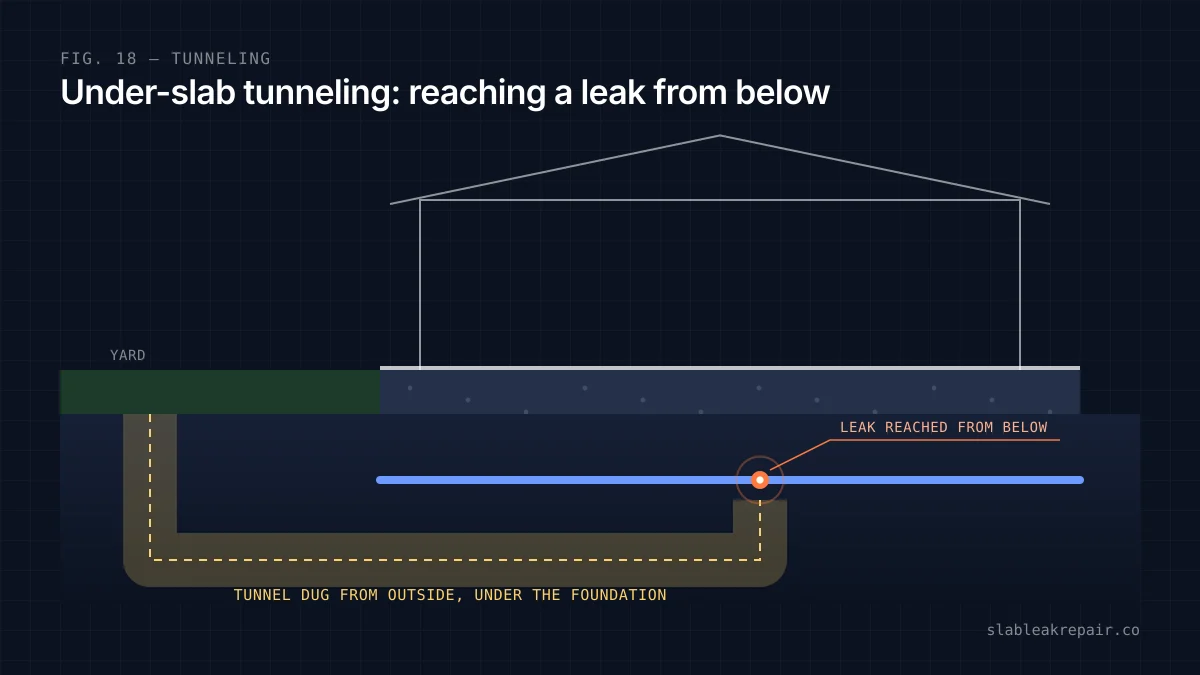
How does under-slab tunneling work?
- The leak is located precisely with pressure, acoustic or thermal testing.
- Utilities are marked by calling 811 before any outdoor digging, as required in every state.[2]
- The crew digs an access pit outside and tunnels under the foundation to the pipe.
- The damaged section is repaired or replaced and pressure-tested.
- The tunnel is backfilled and compacted, and the yard is restored.
What are the pros and cons of tunneling?
| Method | Interior disruption | Main trade-off |
|---|---|---|
| Under-slab tunneling | Little or none | Labor-heavy, often higher cost, yard excavation |
| Direct spot repair | Concrete and flooring opened | Floor restoration afterward |
| Pipe reroute | Wall or ceiling openings | Leaves old pipe abandoned in the slab |
| Epoxy lining | Minimal | Not suitable for every pipe or leak |
When is tunneling the right choice?
Tunneling makes the most sense when the leak is close to an exterior wall, when the floor above is costly to replace, or when the drain or sewer line under the slab must be replaced rather than bypassed. For supply lines, a pipe reroute is often simpler. Compare all options in our repair methods guide.
What should I ask a plumber about tunneling?
- How far is the tunnel, and how will the soil be backfilled and compacted?
- Does the quote include yard and landscaping restoration?
- Is a permit or structural review needed?
- Why is tunneling better than rerouting for this leak?
How do I get help with this repair?
Slab Leak Repair isn’t a plumbing contractor. When you send a request, we look for one independent plumber whose license and insurance we’ve verified and who serves your ZIP code. If we find one, we share your request with them only. If we don’t cover your area yet, we tell you and don’t pass your details on. You’re never obligated to hire anyone.
Safety first: if water is surfacing, shut off the main valve before anything else, keep water away from outlets and appliances, and don’t dig outside without calling 811. See emergency first steps.
Check for a verified plumber in your ZIP code · What to ask before hiring
Frequently asked questions
Is under-slab tunneling safe for my foundation?
Done properly, with the tunnel backfilled and compacted, it is a standard technique. Ask how the contractor will restore the soil and whether a structural review is needed for your home.
Sources
- [1]SERVPRO, “Slab Leak Repair: Signs, Risks & Repair Options.” www.servpro.com/resources/slab-leak-repair (accessed )
- [2]U.S. DOT Pipeline and Hazardous Materials Safety Administration, “Call Before You Dig!.” primis.phmsa.dot.gov/stakeholder-comms/cbyd (accessed )