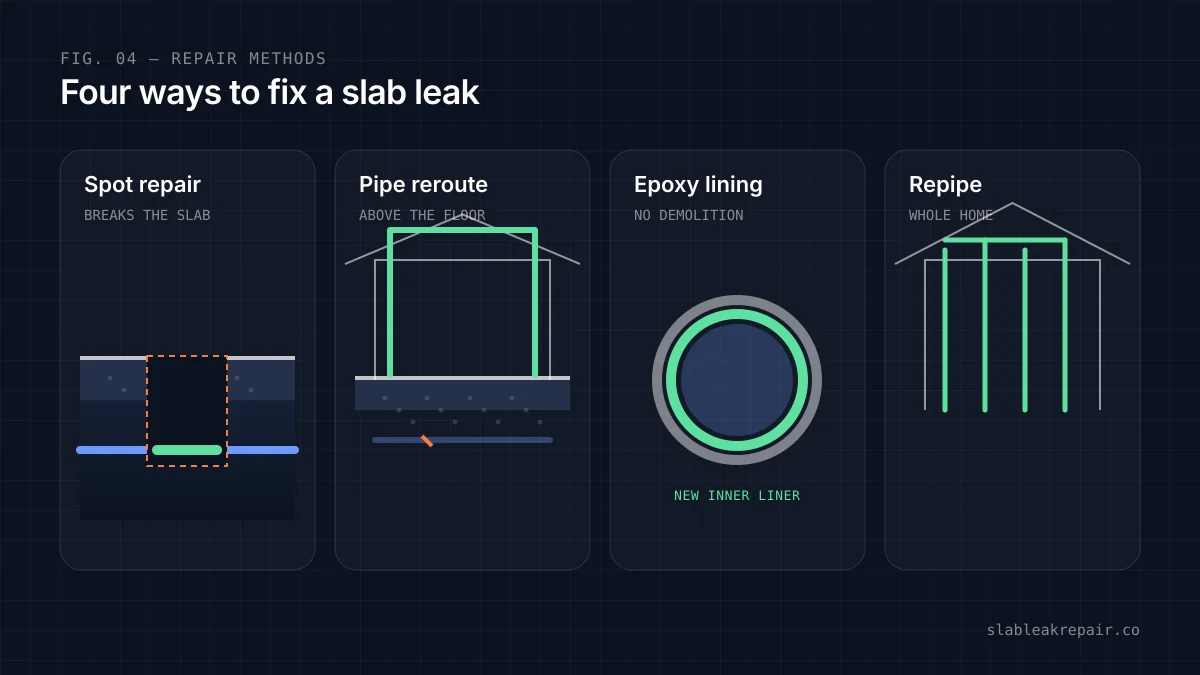
How do the slab leak repair methods compare?
| Method | How it works | Breaks the slab? | Best for | Main trade-off |
|---|---|---|---|---|
| Spot repair | Open the concrete at the leak, fix that section, patch | Yes | One located leak in healthy pipe | Floor and concrete restoration |
| Pipe reroute | Abandon the leaking line, run a new one through walls or attic | No | Expensive floors, or pipe likely to leak again | Wall or ceiling openings |
| Epoxy lining | Clean the pipe and coat it inside with epoxy | No | Small leaks in structurally sound pipe | Not suitable for every pipe or leak |
| Whole-home repipe | Replace most supply lines, usually routed overhead | No | Repeated leaks or aging pipe throughout | Largest project of the four |
| Under-slab tunneling | Dig from outside and reach the pipe from below | No | Leaks near an outside wall, costly floors, drain lines | Labor-heavy, yard excavation |
What is a direct spot repair?
The plumber opens the concrete over the leak, repairs or replaces the damaged section of pipe, tests it, and patches the slab.
- Works well for a single, accurately located leak in otherwise healthy pipe.
- Requires breaking concrete and removing the flooring above it.
- Doesn’t address other weak points in aging pipe.
What is a pipe reroute?
Instead of repairing the leaking line, the plumber abandons it and runs a new line through walls, ceilings or the attic. Read the full pipe rerouting guide.
- Avoids breaking the slab and the floor above it.
- Means opening and patching some walls or ceilings.
- Removes the leaking section from service permanently.
What is epoxy pipe lining?
The pipe is cleaned and coated on the inside with epoxy that seals small leaks and forms a new inner surface.
- Little or no demolition.
- Suitability depends on the pipe’s condition, diameter and type of damage.
- Not every plumber offers it. Ask about local code acceptance and the warranty. More in our epoxy pipe lining guide.
When does a whole-home repipe make sense?
All or most supply lines are replaced, usually routed overhead rather than under the slab.
- Addresses repeated leaks and aging pipe throughout the home.
- The largest project of the four, with the most wall and ceiling work.
- Worth a second opinion before committing.
Frequently asked questions
How much does each slab leak repair method cost?
Angi puts a slab leak reroute at $600 to $4,000 and a pipe leak repair at $250 to $850, before concrete and flooring work.[1] Fixr lists epoxy lining at $500 to $2,000.[2] See the full slab leak repair cost guide.
Is rerouting better than repairing a slab leak?
Neither is better in every home. A spot repair suits one leak in healthy pipe. Rerouting suits homes with costly flooring over the leak, or pipe that’s likely to leak again. Ask the plumber to explain both options for your specific layout.
How long does a slab leak repair take?
It varies with the method and the home. Spot repairs and short reroutes are often finished within a day or two, while whole-home repipes take longer. Floor and wall restoration can add more time, especially if a separate contractor does it.
Sources
- [1]Angi, “How Much Does Foundation Slab Leak Repair Cost?.” www.angi.com/articles/how-much-does-foundation-slab-leak-repair-cost.htm (accessed )
- [2]Fixr, “How much does it cost to repair a slab leak?.” www.fixr.com/costs/slab-leak-repair (accessed )