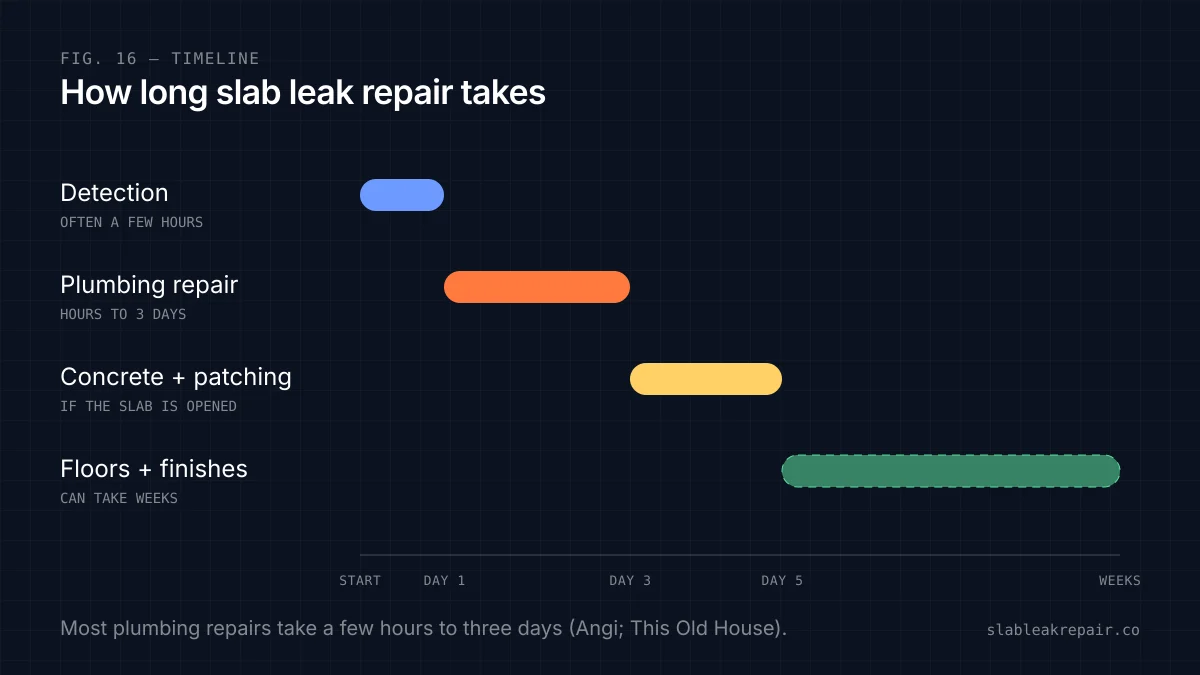
What does a typical slab leak repair timeline look like?
A slab leak job happens in stages. Each one can be quick or slow depending on your home.
| Stage | What happens | What sets the pace |
|---|---|---|
| 1. Detection | Meter and pressure tests confirm a leak; acoustic or thermal tools pinpoint it | How many lines leak and how easy they are to isolate |
| 2. Plumbing repair | Spot repair, reroute, lining or tunneling | Method chosen; few hours to about three days for most jobs |
| 3. Concrete patching | Only if the slab was opened; the patch needs time to set before floors go back | Size of the opening |
| 4. Floors and finishes | Replacing tile, wood, carpet, drywall or cabinets | Material lead times; can take weeks |
Which repair methods are fastest?
A direct spot repair on one located leak is often the shortest plumbing job, but it leaves concrete and flooring to restore. A pipe reroute skips the concrete and replaces it with wall or ceiling patching. Epoxy lining avoids demolition but requires the pipe to be drained, cleaned and cured. Tunneling is usually the slowest because the crew digs under the foundation from outside.[4]
What can make a slab leak repair take longer?
- More than one leak, or a leak that is hard to pinpoint.
- Waiting on a permit or an inspection, which many cities require.
- Insurance adjuster visits before demolition.
- Water damage to floors, walls or cabinets that has to dry out and be replaced.[3]
- A decision to repipe the whole home instead of fixing one leak.
Can I stay in my home during the repair?
Usually, yes. Plumbers can often restore water to the rest of the house between work sessions. Expect noise and dust if the slab is opened, and ask your plumber how long the water will be off each day.
Frequently asked questions
How long does slab leak detection take?
Detection is usually done in one visit. The time depends on how many lines need to be tested and how easy the leak is to hear or see with the equipment. See our slab leak detection guide.
How long can I wait to fix a slab leak?
Not long. A supply-line leak can run nonstop, so damage and water costs keep growing. Shut off the water if it’s surfacing and schedule detection as soon as possible. See emergency first steps.
Sources
- [1]Angi (cost data based on HomeAdvisor research), “How Much Does Slab Leak Repair Cost?.” match.angi.com/cost/plumbing/slab-leak-repair (accessed )
- [2]This Old House, “Slab Leak Repair Cost.” www.thisoldhouse.com/foundations/reviews/slab-leak-repair-cost (accessed )
- [3]HomeGuide, “How much does a slab leak repair cost?.” homeguide.com/costs/slab-leak-repair-cost (accessed )
- [4]SERVPRO, “Slab Leak Repair: Signs, Risks & Repair Options.” www.servpro.com/resources/slab-leak-repair (accessed )