How much does slab leak detection cost?
Angi reports that slab leak detection averages about $280, with most homeowners paying $150 to $600.[2] Price depends on how many lines need testing, the equipment used and how hard the leak is to pinpoint. Detection is usually billed separately from the repair, and it’s money well spent: knowing exactly where the leak is limits how much floor gets opened. See the full cost guide.
How do I check my water meter for a leak?
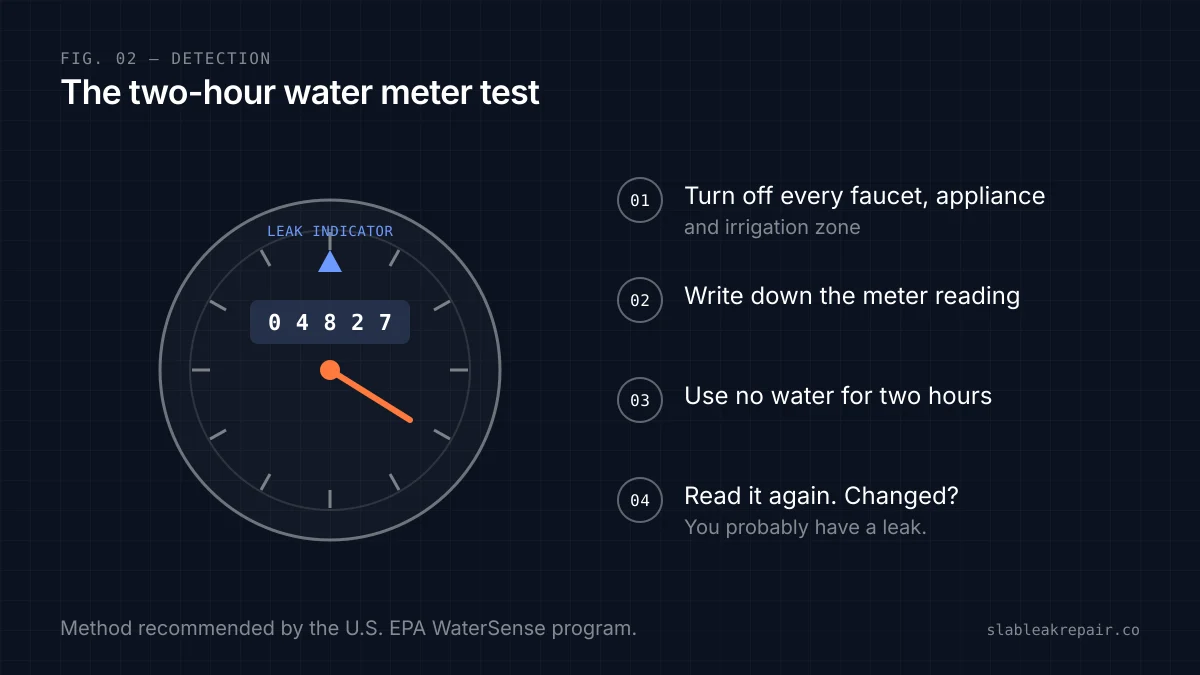
The EPA’s WaterSense program recommends checking your meter before and after a two-hour period when no water is being used.[1] It tells you whether water is leaving your plumbing, not where. A running toilet, an irrigation system or a main water line leak in the yard can produce the same result, so rule those out first.
- Turn off every faucet, appliance and irrigation zone, and make sure no toilet is refilling.
- Find your water meter, usually in a box near the street, and write down the reading.
- Use no water at all for two hours.
- Read the meter again. If it changed, you probably have a leak somewhere.[1]
Can my water bill reveal a hidden leak?
It can. WaterSense notes that if a family of four uses more than 12,000 gallons a month in winter, when outdoor watering is low, there could be serious leaks.[1] Compare winter bills from year to year for an unexplained jump.
How do plumbers find a leak under concrete?
Plumbers often combine several methods. Each has strengths, and none is perfect in every home.
- Pressure testing isolates individual lines, such as hot versus cold, to show which one is losing pressure.
- Acoustic equipment listens through the floor for the sound of water escaping a pressurized pipe.
- Thermal imaging can reveal warm areas over a leaking hot-water line.
- Line locating traces the route of pipes under the slab so the search area is accurate.
- Camera inspection is used for drain lines under the slab, sending a camera through the pipe.
How accurate is slab leak detection?
Detection narrows the leak to an area. Before any concrete is opened, ask how confident the plumber is in the location and what happens if the first opening misses the leak.
How should I prepare for a leak detection appointment?
- Know where your main water shutoff is.
- Have a few recent water bills handy to show any change in usage.
- Write down what you’ve noticed and where: warm spots, sounds, damp flooring.
- Clear access to the water heater, the main shutoff and the areas of concern.
How do I get help with this repair?
Slab Leak Repair isn’t a plumbing contractor. When you send a request, we look for one independent plumber whose license and insurance we’ve verified and who serves your ZIP code. If we find one, we share your request with them only. If we don’t cover your area yet, we tell you and don’t pass your details on. You’re never obligated to hire anyone.
Safety first: if water is surfacing, shut off the main valve before anything else, keep water away from outlets and appliances, and don’t dig outside without calling 811. See emergency first steps.
Check for a verified plumber in your ZIP code · What to ask before hiring
Frequently asked questions
Can I find a slab leak myself?
You can confirm that a leak exists with a two-hour water meter test, and rule out toilets and irrigation. Pinpointing a leak under concrete takes professional equipment, so book a leak detection appointment before anyone breaks the slab. More in can you fix a slab leak yourself?
Does leak detection damage my floors?
No. Pressure tests, acoustic listening, thermal imaging and line tracing are non-invasive. Floors are only opened later, for the repair itself, and only if you choose a method that goes through the slab.
Sources
- [1]U.S. Environmental Protection Agency, WaterSense, “Fix a Leak Week.” www.epa.gov/watersense/fix-leak-week (accessed )
- [2]Angi (cost data based on HomeAdvisor research), “How Much Does Slab Leak Repair Cost?.” match.angi.com/cost/plumbing/slab-leak-repair (accessed )