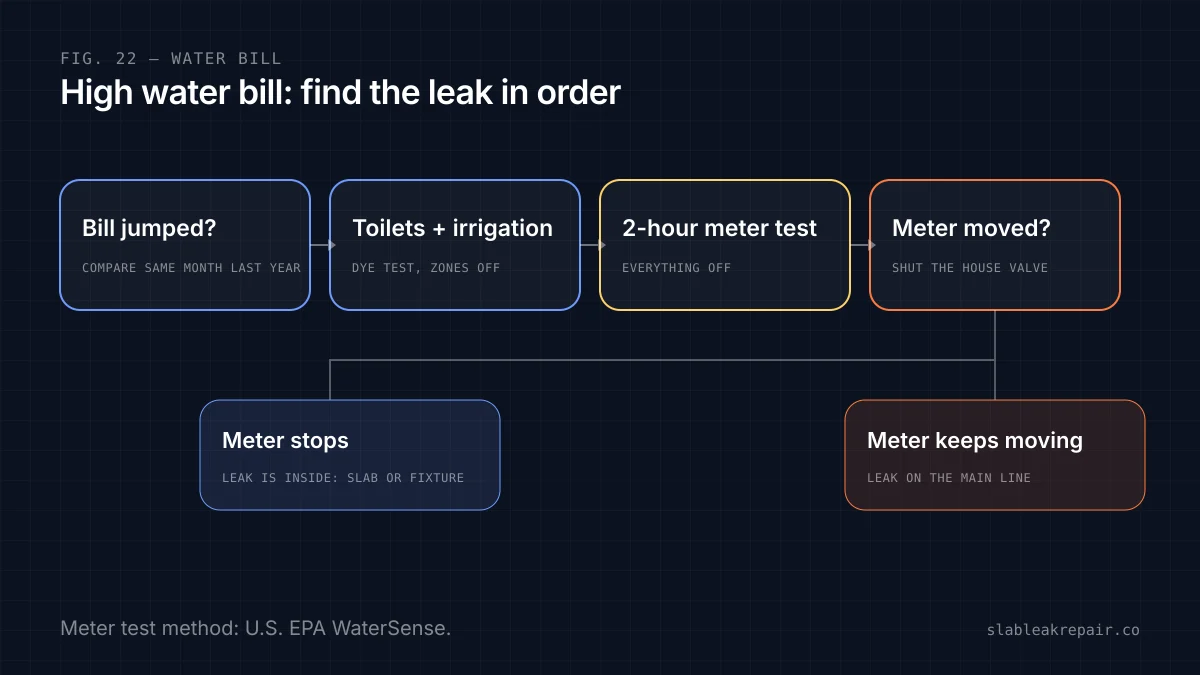
What should I check first when my water bill is high?
Work from the most common and easiest causes to the least common:
- Compare this bill with the same month last year to make sure it isn’t a rate change or a seasonal pattern.
- Listen for running toilets and check flappers. A constantly running toilet can waste 200 gallons or more a day.[1]
- Check outdoor faucets, hoses, pools and irrigation zones, including the backflow valve.
- Run the two-hour water meter test with every fixture, appliance and irrigation zone off.[2]
- If the meter moves, shut the main valve at the house. If the meter stops, the leak is inside; if it keeps moving, it’s on the line between the meter and the house.
When does a high water bill point to a slab leak?
A slab leak becomes the likely explanation when the meter moves with everything off and you’ve ruled out toilets and outdoor lines, especially if you also notice warm spots on the floor, damp flooring or the sound of running water. See all the warning signs. A plumber confirms it by isolating the hot, cold and drain lines and pinpointing the leak with detection equipment.
| Cause | Typical clue | How to check |
|---|---|---|
| Running toilet | Hissing or refilling with no flush | Dye tablet in the tank; color in the bowl means a leak |
| Irrigation leak | Soggy patch of lawn, bills higher in summer | Turn off irrigation and recheck the meter |
| Main water line leak | Wet yard between meter and house | Meter still moves with the house valve shut |
| Slab leak | Warm floor spots, damp flooring, sound of water | Meter moves with everything off; plumber confirms |
How much water can a hidden leak waste?
It depends on the size of the leak, which is why measuring it helps. Our water leak cost estimator turns two meter readings into gallons per day and, with the rate from your bill, dollars per month. The EPA also suggests a quick benchmark: a family of four using more than 12,000 gallons in a winter month likely has a serious leak.[1]
Can I get my water bill adjusted after a leak?
Many water utilities credit part of a leak-inflated bill once you show the leak was repaired, usually with a plumber’s invoice. Rules differ a lot: deadlines run from 15 days to 12 months, and only some policies name hidden or under-slab leaks. Our leak adjustment database checks the leak adjustment rules of 50 US utilities against their official sources. Keep every receipt and the dates of the high bills. For the step-by-step process, documents and a sample request, see how to request a water bill leak adjustment.
Frequently asked questions
Can a slab leak double my water bill?
It can raise it sharply, because a leak in a pressurized supply line runs around the clock. The only way to know how much water is escaping is to measure it at the meter.
Sources
- [1]U.S. Environmental Protection Agency, WaterSense, “Fix a Leak Week: Leak facts and tips.” www3.epa.gov/watersense/pubs/fixleak.html (accessed )
- [2]U.S. Environmental Protection Agency, WaterSense, “Fix a Leak Week.” www.epa.gov/watersense/fix-leak-week (accessed )