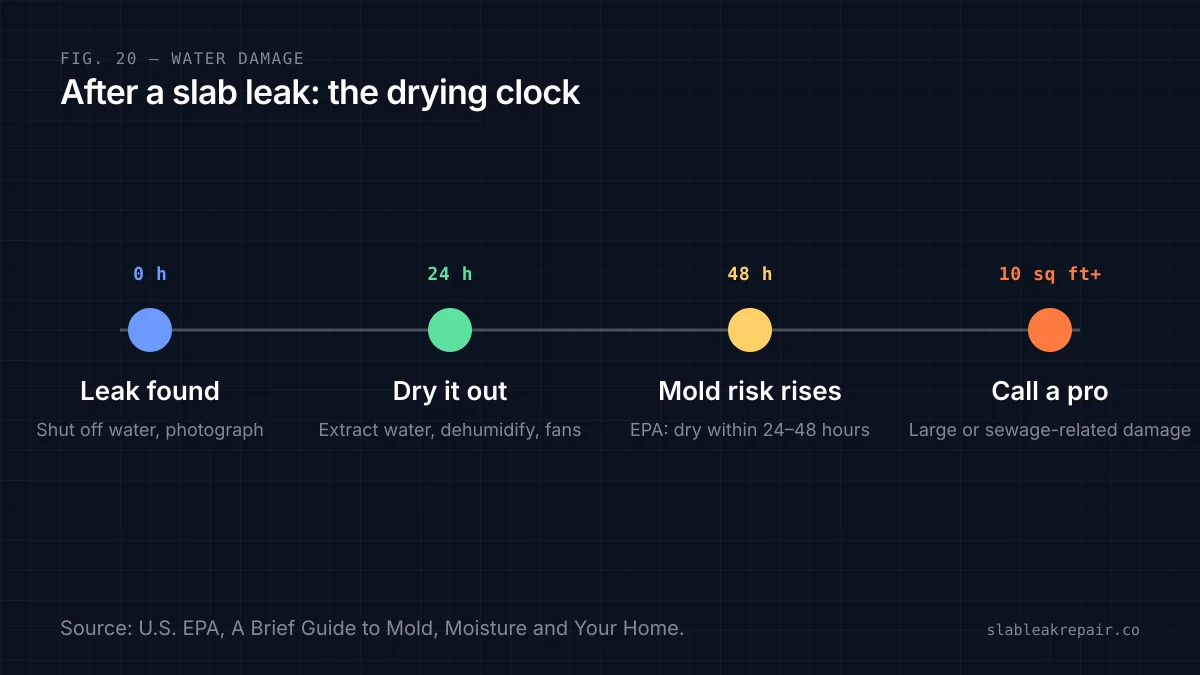
What should I do about water damage right away?
- Shut off the main water valve if water is surfacing. See emergency first steps.
- Photograph everything before you move or throw anything away, and notify your insurer.
- Pull up wet rugs and move furniture off damp floors.
- Start drying: remove standing water, run fans and a dehumidifier, and open up wet areas to air.
- Book leak detection so the source is found and fixed. Drying won’t hold while the pipe keeps leaking.[1]
How fast does mold grow after a slab leak?
The EPA’s guidance is to dry water-damaged areas and items within 24 to 48 hours to prevent mold growth.[1] A slab leak is harder than a burst pipe in a wall because water can sit under flooring and inside the slab for days before anyone notices, so materials may already be past that window when the leak is found.
What usually needs to be removed or replaced?
Hard, non-porous surfaces can often be cleaned and dried. Absorbent materials such as carpet pad, drywall and particleboard cabinet bases are harder to save once they’ve stayed wet, and moldy absorbent materials may need to be replaced.[1] Wood and laminate floors can cup or swell and may need to come up so the slab underneath can dry.
When should I hire a water damage or mold professional?
Will insurance pay for slab leak water damage?
Policies often treat sudden water damage differently from the pipe repair itself, and long-running leaks or mold may be limited or excluded. Read our insurance guide and document the damage before cleanup.
Frequently asked questions
Can I paint over mold after a slab leak?
No. The EPA advises cleaning up mold and drying surfaces before painting, because paint over mold is likely to peel and the mold remains.[1]
Sources
- [1]U.S. Environmental Protection Agency, “A Brief Guide to Mold, Moisture and Your Home.” www.epa.gov/mold/brief-guide-mold-moisture-and-your-home (accessed )