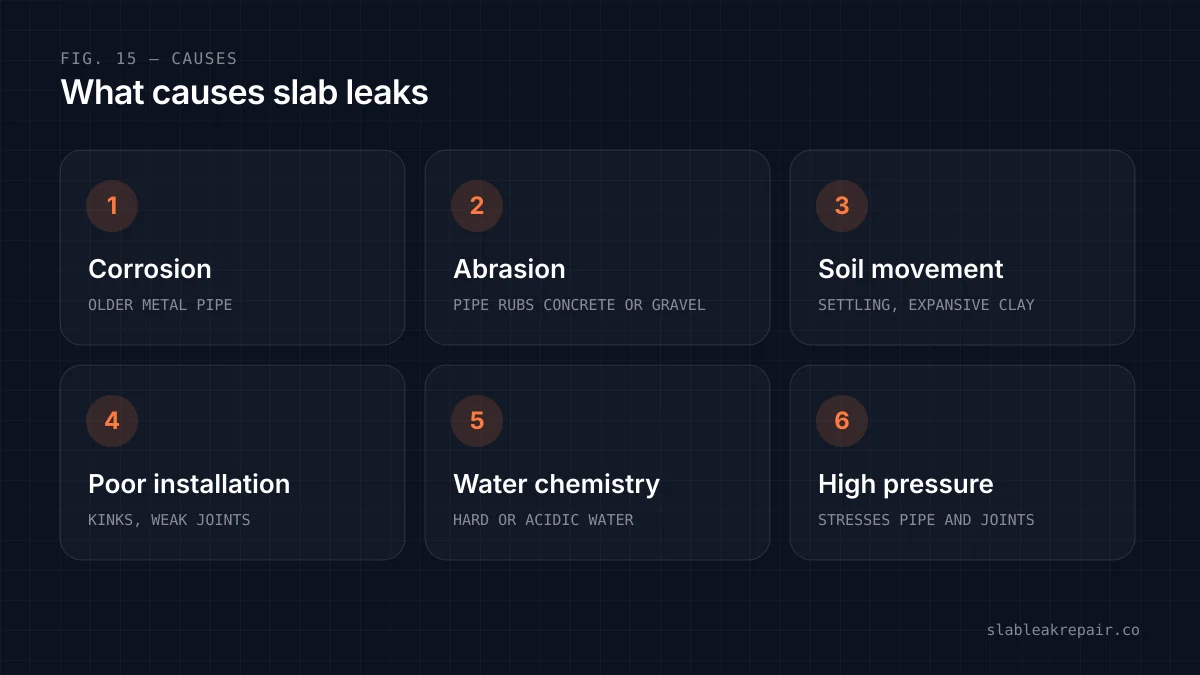
What are the most common causes of slab leaks?
- Corrosion: older copper or galvanized pipe can thin from the inside, or from contact with soil, until pinholes form.
- Abrasion: hot-water lines expand and contract; where a pipe rubs against concrete, gravel or another pipe, the wall wears through.
- Soil movement: settling, shifting or expansive clay soils put stress on pipes embedded in or under the slab, and a leak can make that movement worse. See how slab leaks affect foundations.
- Poor installation: kinked or dented pipe and weak joints made during construction can fail years later.
- Water chemistry: very hard or acidic water can speed up wear on some pipe materials.
- High water pressure: constant excess pressure stresses pipe walls and joints.
Which homes are most at risk?
Slab-on-grade homes with older metal supply lines run under the concrete face the highest risk, especially in areas with shifting or expansive soils. A home that has already had one slab leak is more likely to have another on the same line.
Can slab leaks be prevented?
Not entirely, but you can catch them early and reduce stress on your pipes. The EPA recommends checking your water meter before and after a two-hour period with no water use; if the reading changes, you probably have a leak.[1]
- Run the two-hour water meter test a couple of times a year.
- Ask a plumber to check your water pressure and pressure regulator.
- Watch for the warning signs of a slab leak and act early.
- After a first leak, ask whether rerouting makes more sense than another spot repair.
Frequently asked questions
Does one slab leak mean more are coming?
Not always, but often. If the cause was corrosion, water chemistry or age, other sections of the same pipe may be just as worn. A plumber can tell you whether the pipe is generally sound or near the end of its life.
Can tree roots cause a slab leak?
Roots more commonly damage drain and sewer lines and the main water line in the yard. Under a slab, corrosion, abrasion and soil movement are more typical causes.
Sources
- [1]U.S. Environmental Protection Agency, WaterSense, “Fix a Leak Week.” www.epa.gov/watersense/fix-leak-week (accessed )