What is a pinhole leak in a copper pipe?
It is a leak from a pit of corrosion that eats through the pipe wall at one small spot. The rest of the pipe can look sound. Researchers writing in AWWA Water Science estimated that about 750,000 pinhole leaks occur in the United States each year, and called the cause still poorly understood.[1] The Water Research Foundation has documented them in all 50 states.[2]

What causes pinhole leaks in copper pipes?
The American Society of Plumbing Engineers says pitting corrosion and erosion corrosion are the more common causes of pinhole leaks in copper systems.[3] Factors researchers have linked to pitting include:
- Water chemistry. A Virginia Tech study of one aggressive test water found free chlorine was a driving factor in pitting, and that low alkalinity increased corrosion.[4]
- Flow velocity. The same study found that higher water velocity significantly increased pitting;[4] fast-moving water at elbows and tees can also wear the wall away (erosion corrosion).
- Biological activity. A 30-year review found evidence that microbes are likely involved in some pitting, and that the effect of corrosion inhibitors can cut both ways.[1]
- Changes in water treatment. One Maryland utility began adding orthophosphate, a corrosion inhibitor, on the advice of copper corrosion experts after a wave of pinhole leak reports.[2]
What are the signs of a pinhole leak?
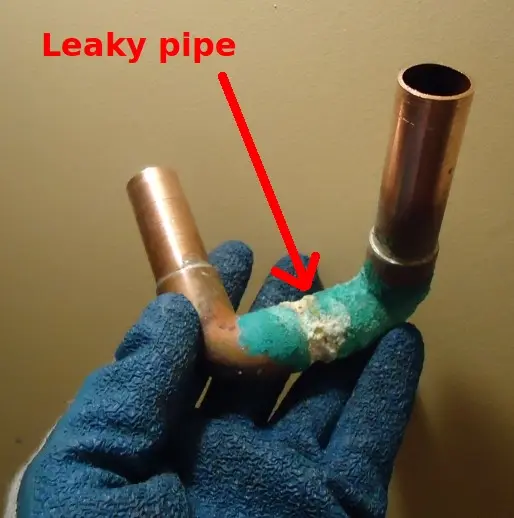
On exposed pipe you may see a fine spray, a drip, water stains, or blue-green corrosion around a fitting. Blue-green stains are a sign of corrosion but do not always mean a pinhole.[5] Inside walls or under a slab you are more likely to notice the effects: a higher bill, a meter that moves with everything off, a warm spot on the floor over a hot-water line, or damp flooring. See signs of a slab leak.
Can a pinhole leak be repaired, or do I need to repipe?
A single pinhole on exposed pipe is usually a quick spot repair: the plumber cuts out the damaged section and joins in new pipe, as in the photo above. Under a slab, the same repair means reaching the pipe first, which is why many plumbers suggest a reroute instead.
Repeat pinholes are the warning sign. If several leaks appear on the same system, the remaining copper has likely thinned too, and a reroute or a whole-house repipe is often better value than repeated repairs. Angi reports that replacing a single section of pipe typically costs $149 to $5,800, around $1,252 on average.[6]
| Situation | Common approach | Why |
|---|---|---|
| First pinhole, exposed pipe | Cut out and replace the section | Fast, low cost |
| First pinhole, under the slab | Spot repair or reroute the line | Depends on access and pipe condition |
| Repeat pinholes | Reroute or repipe | The remaining pipe is likely thinning |
Can I prevent pinhole leaks?
You cannot control your utility’s water chemistry, but you can ask for its water quality report and whether it uses a corrosion inhibitor. Keeping water pressure within the normal range limits stress and velocity. If a water treatment company suggests a fix, ask what evidence links it to copper pitting in your area.
Frequently asked questions
Is my water utility responsible for pinhole leaks?
Usually not. Utilities are generally responsible for their own mains and meters, and pipes on your side of the meter are yours to maintain. Ask your utility about its water treatment if pinholes keep appearing in your area.
Do pinhole leaks happen in PEX pipe?
Pinhole leaks from pitting corrosion are a metal-pipe problem. PEX can fail in other ways, such as at fittings or from physical damage, but it does not corrode like copper.
Are epoxy liners a fix for pinhole leaks?
Lining can seal small leaks from inside the pipe in some systems. Results depend on the pipe’s condition and the installer. See our epoxy pipe lining guide before choosing it.
Sources
- [1]McMaster University Experts, “A 30-year review of copper pitting corrosion and pinhole leaks: Achievements and research gaps (AWWA Water Science, 2021).” experts.mcmaster.ca/display/publication1971717 (accessed )
- [2]WSSC Water, “Copper pipe pinhole leaks.” wsscwater.com/copper-pipe-pinhole-leaks (accessed )
- [3]American Society of Plumbing Engineers, “Copper corrosion and the changing water environment.” aspe.org/pipeline/?p=3504 (accessed )
- [4]Virginia Tech, “Influences of Water Chemistry and Flow Conditions on Non-Uniform Corrosion in Copper Tube (thesis).” vtechworks.lib.vt.edu/bitstream/handle/10919/34388/Custalow_Thesis_2.pdf (accessed )
- [5]Butler County Water and Sewer, Ohio, “Pinhole leaks.” www.bcohio.gov/board_of_commissioners/commissioner_departments/water_sewer/pinhole_leaks.php (accessed )
- [6]Angi, “What Does Pipe Replacement Cost for a Single Pipe or Project?.” angi.com/articles/how-much-does-installing-or-replacing-plumbing-pipes-cost.htm (accessed )