What should water pressure be in a house?
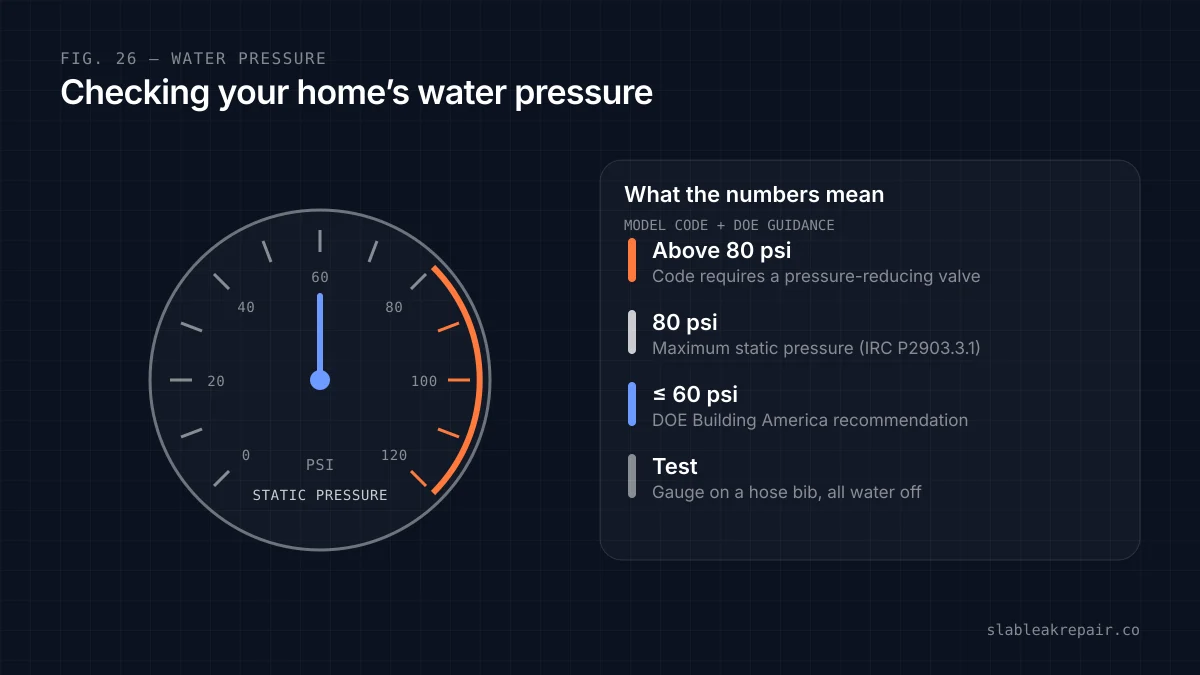
The 80 psi figure is a ceiling, not a target. The International Residential Code (section P2903.3.1, in the 2021 and 2024 editions) caps static pressure at 80 psi and requires an approved pressure-reducing valve when pressure is higher.[1][2] Cities and states adopt code editions on their own schedules and sometimes amend them, so your local plumbing code is the rule that applies. The Pacific Northwest National Laboratory’s Building America guidance goes further for new homes and recommends verifying that static service pressure is no more than 60 psi.[3] Many plumbers set a pressure-reducing valve somewhere in the 60 to 70 psi range for comfort and margin.
How do I test my home’s water pressure?
A pressure gauge with a hose thread costs little at a hardware store. To read static pressure:
- Turn off every faucet, appliance and irrigation zone inside and outside.
- Screw the gauge onto an outdoor faucet nearest the main line, or onto the washing machine supply.
- Open the faucet fully and read the gauge.
- Check again at a different time of day; street pressure often rises at night when demand drops.
- If the needle reads above 80 psi, or keeps creeping up after the valve is closed, have a plumber look at the pressure-reducing valve.
What does my pressure reading mean?
Use the static reading (no water running) and compare it with these reference points from the model code, DOE guidance and Moen:[1][3][4]
| Static reading | What it means | Typical next step |
|---|---|---|
| Above 80 psi | Above the model code limit | Have a plumber install, adjust or replace the pressure-reducing valve |
| 61 to 80 psi | Within the code limit | Fine for most homes; consider a lower setting if a plumber recommends it |
| 60 psi or less | At or under the DOE Building America new-home target | No action needed for pressure |
| Rises overnight or after use | Valve may not be holding, or water is expanding when heated | Ask a plumber to check the valve and the need for an expansion tank |
Can high water pressure cause slab leaks?
It is one of several contributing factors. Higher pressure puts more stress on pipes, joints and fixtures, and faster flow can add to erosion inside copper pipe. That is why pressure control appears on most lists of ways to prevent slab leaks. It is rarely the only cause; see what causes slab leaks.
What does a pressure-reducing valve do, and how long does it last?
A pressure-reducing valve (PRV) sits on the main line, usually near the main shutoff, and lowers street pressure to a set level. Moen notes that homes built after the 1980s usually already have one and suggests considering replacement once a valve is more than about ten years old.[4] Signs of a failing valve include pressure that drifts up, banging pipes, dripping relief valves and running toilets.
HomeGuide reports that replacing a PRV typically costs $300 to $650, around $475 on average, including parts and labor.[5] Moen gives a similar ballpark of about $350 for professional installation.[4]
What if my water pressure is too low?
Low pressure at every fixture can point to a partly closed main valve, a failing PRV, a clogged line, or a leak big enough to steal flow, such as a break in the main water line or under the slab. If pressure dropped suddenly and the meter moves with everything off, treat it as a possible leak and follow the emergency steps.
Frequently asked questions
Is 100 psi water pressure too high for a house?
Yes. Model plumbing codes require a pressure-reducing valve whenever static pressure exceeds 80 psi. At 100 psi, have a plumber install or adjust a valve.
Can I adjust my pressure-reducing valve myself?
Many valves have an adjustment screw on top, and turning it changes the downstream pressure. If the valve will not hold a setting, it usually needs replacing, which involves cutting into the main line and is best left to a plumber.
Do I need an expansion tank with a pressure-reducing valve?
Often. A PRV can create a closed system, and water heated in the tank has nowhere to expand. Many local codes then require a thermal expansion tank. Ask your plumber what your jurisdiction requires.
Sources
- [1]Jaspector (code reference), “IRC 2021 P2903.3.1: High water pressure requires pressure regulation.” www.jaspector.com/codes/irc-2021/ch29-water-supply/maximum-water-pressure-prv/ (accessed )
- [2]Jaspector (code reference), “IRC 2024 P2903.3.1: Pressure reducing valve required when street pressure exceeds 80 psi.” www.jaspector.com/codes/irc-2024/ch29-water-supply/pressure-reducing-valve-irc-2024/ (accessed )
- [3]Pacific Northwest National Laboratory, Building America Solution Center, “Service Water Pressure.” basc.pnnl.gov/resource-guides/service-water-pressure (accessed )
- [4]Moen, “Pressure Reducing Valves (PRV).” solutions.moen.com/Moen_Flo_Shutoff/Get_to_know_your_Product/Pressure_Reducing_Valves_(PRV) (accessed )
- [5]HomeGuide, “How much does it cost to replace a water pressure regulator?.” homeguide.com/costs/cost-to-replace-water-pressure-regulator (accessed )