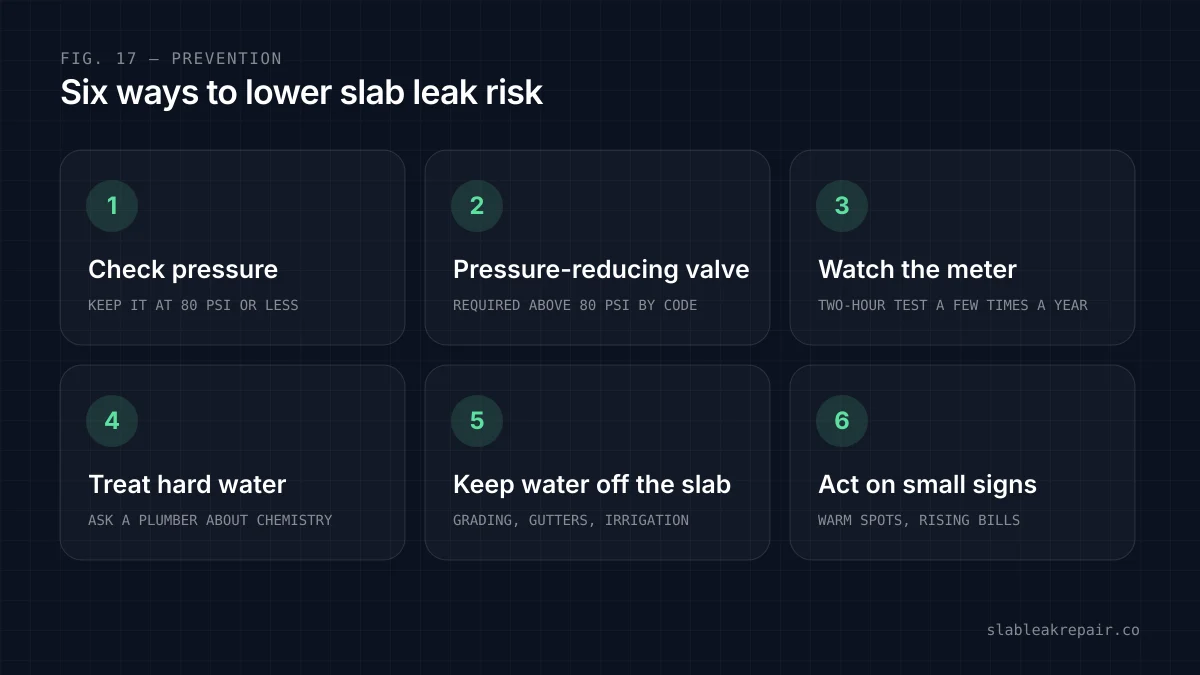
What can I do to prevent a slab leak?
- Check your water pressure with an inexpensive gauge on an outdoor spigot. Readings above 80 psi are higher than most plumbing codes allow.[1]
- If pressure is high, have a plumber install or adjust a pressure-reducing valve. Higher pressures can rupture pipes and damage fixtures.[2]
- Run the EPA’s two-hour water meter test a few times a year to catch hidden leaks early.[3]
- Ask a plumber whether your water chemistry, such as very hard water, is wearing your pipes.
- Keep gutters, grading and irrigation sending water away from the slab, so the soil stays stable.
- Don’t ignore warm floor spots, a rising bill or the sound of running water. See the warning signs.
Why does water pressure matter so much?
Pipes under a slab are under constant pressure. The International Plumbing Code requires a pressure-reducing valve where static pressure in a building exceeds 80 psi,[1] and the U.S. Department of Energy’s Building America guidance notes that higher pressures can rupture pipes and damage fixtures.[2] A failing valve can let pressure creep up over time, so test again every year or two.
What if I’ve already had one slab leak?
A second leak in the same plumbing is common when pipes are aging or corroded. If you’ve had more than one, ask about a pipe reroute or a whole-home repipe instead of another spot repair. Our causes guide explains why leaks repeat.
Frequently asked questions
Can you completely prevent slab leaks?
No. Soil movement, pipe age and original installation are mostly outside your control. Managing pressure, catching leaks early and fixing drainage lower the risk and limit damage.
What water pressure is safe for a house?
Most plumbing codes cap household pressure at 80 psi and require a pressure-reducing valve above that.[1] Your plumber can recommend a setting for your home.
Sources
- [1]International Code Council, “International Plumbing Code, Chapter 6, Section 604.8: Water-pressure reducing valve or regulator.” codes.iccsafe.org/content/IPC2012/chapter-6-water-supply-and-distribution (accessed )
- [2]U.S. Department of Energy Building America Solution Center (PNNL), “Service Water Pressure.” basc.pnnl.gov/resource-guides/service-water-pressure (accessed )
- [3]U.S. Environmental Protection Agency, WaterSense, “Fix a Leak Week.” www.epa.gov/watersense/fix-leak-week (accessed )