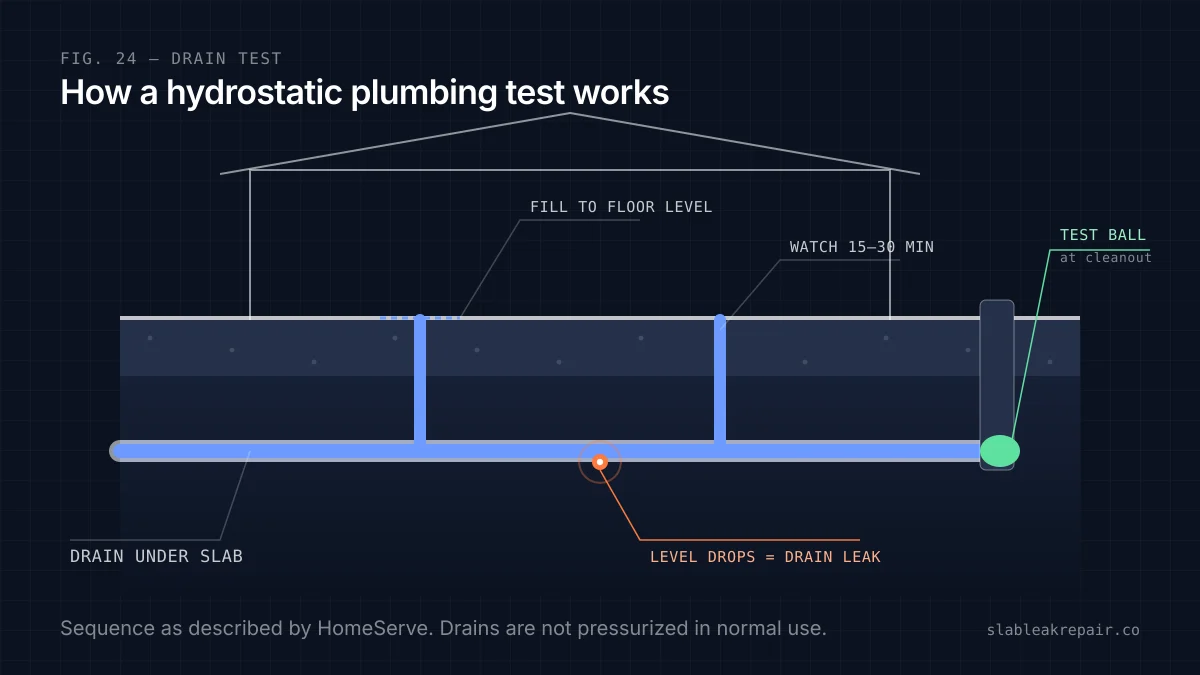
What is a hydrostatic plumbing test?
It is a leak test for drain, waste and sewer lines, which normally carry water by gravity and are never under pressure. The plumber seals the system and fills it with standing water so that any crack, separated joint or rotted pipe bottom lets water out and the level falls.
It is different from the pressure test used on water supply lines, which pressurizes the copper or PEX lines and watches a gauge. A home can pass one and fail the other, because they test different pipes. See supply vs. drain leaks under the slab.
How does a plumber run a hydrostatic test?
The basic sequence described by HomeServe is:[1]
- Find the main cleanout or another access point on the building drain.
- Insert an inflatable test ball and inflate it to seal the line.
- Fill the isolated section with water, usually up to the level of the lowest floor drain or toilet flange.
- Watch the water level, usually for about 15 to 30 minutes.
- If the level drops, repeat the test on smaller sections to narrow down where the leak is.
How much does a hydrostatic plumbing test cost?
HomeServe, citing a Texas plumbing company, puts a professional test at about $250 to $500, with the price rising when there are several cleanouts or when isolation testing is needed to find the leak.[1] Treat any figure as a starting point and ask for a written quote that says what happens, and what it costs, if the first test fails.
When is a hydrostatic test worth doing?
It is most useful when a drain leak is a real possibility and the answer will change a decision:
- Before buying an older slab-on-grade home, especially one with cast iron drains. See buying a house with a slab leak.
- After foundation leveling. One Texas foundation repair company advises always getting a hydrostatic plumbing test after foundation repair, because pipes can break when a house is lifted.[2]
- When floors are settling or cracking near bathrooms or the kitchen and the water supply has already passed a pressure test.
- When a sewer odor, slow drains or damp floor coverings point to the drain side.
What are the limits of a hydrostatic test?
The test fills drain lines higher than they ever run in normal use. Defense-side engineers quoted by Insurance Journal argue that because drains are not normally pressurized, the test will almost always show some loss, and that a failed test alone does not prove the whole system needs replacing.[3] Plaintiffs’ experts in Florida pipe claims often rely on the same test.[3]
The practical answer is to treat a failed test as the start of the diagnosis, not the end. Ask the plumber to isolate sections and follow up with a camera inspection, so you see the actual defect before anyone quotes a full replacement.
What happens if the hydrostatic test fails?
Next comes isolation testing and a video inspection of the drain to locate the damage. Repair options range from a spot repair through the slab to rerouting the drain, tunneling under the foundation or, for some pipes, lining. See slab leak repair methods and tunneling under a slab.
Frequently asked questions
Can a hydrostatic test damage my plumbing?
The test fills the drains with standing water rather than pumping in pressure, but a badly deteriorated pipe can leak more while it is full. Ask the plumber how they will drain the system afterward and what they will do if water appears.
How long does a hydrostatic test take?
The watch period for each section is usually about 15 to 30 minutes. Setup, isolating sections and draining the system add time, so plan for a longer appointment if the house has several branches.
Is a hydrostatic test the same as a sewer camera inspection?
No. The camera shows the inside of the pipe and the location of defects; the hydrostatic test shows whether the system holds water. They answer different questions and are often used together.
Sources
- [1]HomeServe, “What Is a Hydrostatic Test For Your Plumbing?.” www.homeserve.com/blog/home-improvement/hydrostatic-plumbing-test (accessed )
- [2]HD Foundation Repair, “Why get a plumbing test after foundation repair?.” hdfoundationrepair.com/why-get-a-plumbing-test-after-foundation-repair/ (accessed )
- [3]Insurance Journal, “Cast Iron Drainpipes Latest Target in Florida Claims. But They Can Be Defended..” insurancejournal.com/news/southeast/2022/06/20/672576.htm (accessed )