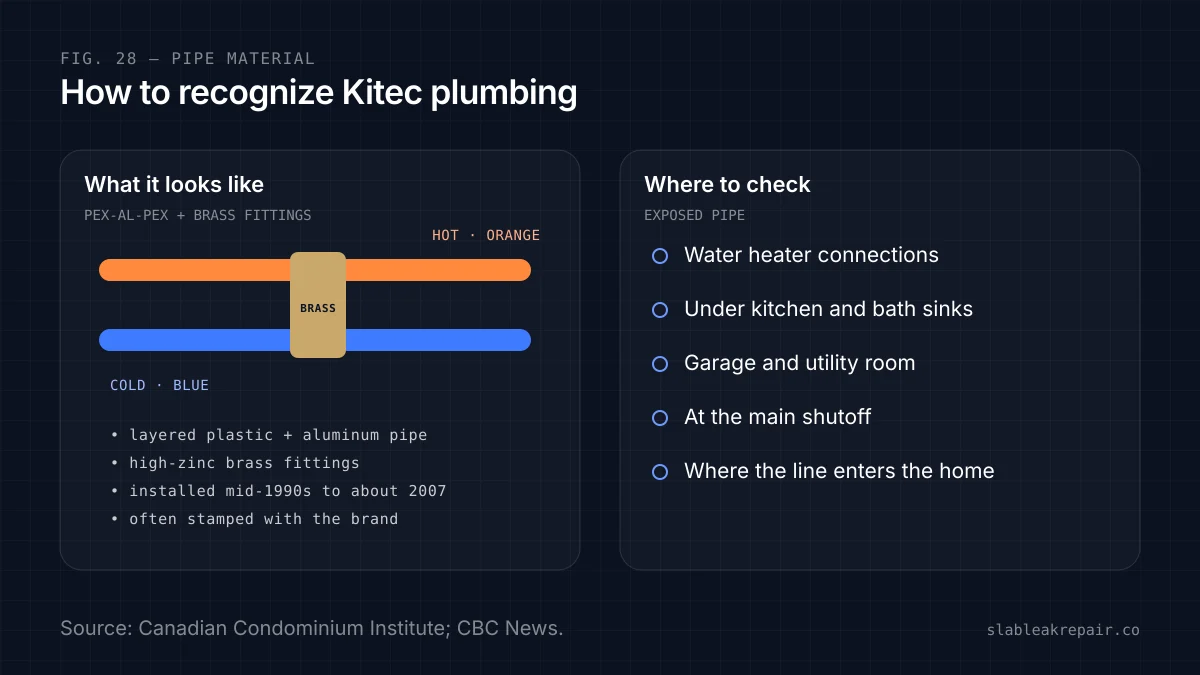
What is Kitec plumbing?
Kitec is a brand of PEX-aluminum-PEX (PEX-AL-PEX) water pipe and brass fittings made by IPEX. The Canadian Condominium Institute says it was installed in houses and low- and high-rise residential buildings in the U.S. and Canada from the mid-1990s until about 2007.[1] CBC News reported that it was also sold under other names, including PlumbBetter, IPEX, AQUA and WARMRITE.[2]
How do I know if I have Kitec pipes?
Look where the plumbing is exposed: at the water heater, under sinks, in the garage or utility room, at the main shutoff and where the line enters the home. The pipe is usually bright orange or bright blue.[1] CBC described blue and orange flexible piping with brass fittings, carrying cold and hot water.[2] Fittings and pipe are often stamped with the brand name. If you are not sure, ask a plumber or inspector to confirm.
Why does Kitec fail?
There are two problems. First, the brass fittings have a high zinc content and can fail early through dezincification, in which zinc leaches out and leaves the fitting weak and clogged.[1] The Las Vegas Sun reported that leached zinc can build up in connecting pipes and that the Las Vegas Valley’s hard water was blamed for corroding the fittings.[3] Second, the layered pipe itself is considered defective and can rupture over time, especially carrying hot chlorinated water.[1]
The Canadian Condominium Institute says Kitec can start to fail about 8 to 10 years after installation, with failures becoming more frequent after that,[1] which means most systems are now well past that point.
Can I still claim money from the Kitec class action?
Most likely not. A class action filed in 2007 settled around 2011 with a fund of US$125 million, and the claim deadline was January 9, 2020, according to a 2022 Canadian Condominium Institute article.[1] Separately, a 2008 settlement in Nevada covered an estimated 34,000 Las Vegas Valley homeowners.[3] Homeowners today generally pay for replacement themselves or seek recovery from builders and installers through their own counsel.
How is Kitec different from polybutylene?
Both are discontinued plastic water pipes with failure histories, and they are easy to confuse. The key differences, based on the Canadian Condominium Institute and InterNACHI:[1][4]
| Feature | Kitec | Polybutylene |
|---|---|---|
| Installed | Mid-1990s to about 2007 | 1978 to mid-1995 |
| Usual look | Bright orange (hot) and blue (cold) | Usually gray, often stamped PB2110 |
| Main weakness | High-zinc brass fittings (dezincification) and the layered pipe | Pipe degraded by disinfectants in water |
| Settlement status | Claim deadline passed January 9, 2020 | Settlement programs long closed |
What should I do if my home has Kitec plumbing?
Most plumbers recommend replacing it rather than waiting for a failure. In a slab home, supply lines that run under the slab are typically abandoned and new PEX or copper is run through the attic and walls, much like a pipe reroute. Compare whole-house costs in repair vs. repipe, and choose the new material with our PEX vs. copper guide. Until then, know where your main shutoff is and consider an automatic shutoff valve.
Frequently asked questions
Is Kitec the same as PEX?
Not exactly. Kitec is a layered PEX-aluminum-PEX pipe with its own brass fittings. Modern PEX systems use different fittings and are widely installed today.
Can I replace only the Kitec fittings?
Some plumbers replace failing fittings as a stopgap, but the pipe itself is also considered defective, so whole-system replacement is the more common recommendation.
Does Kitec affect selling a home?
It can. Buyers, inspectors and insurers may flag it. Replacing it before listing, with invoices and permits, removes a common objection.
Sources
- [1]Canadian Condominium Institute, “What are Kitec pipes and why are they problematic?.” cci.ca/resource-centre/view/1333 (accessed )
- [2]CBC News, “Faulty pipes cause headaches for homeowners.” amp.cbc.ca/news/canada/windsor/faulty-pipes-cause-headaches-for-homeowners-1.1000605 (accessed )
- [3]Las Vegas Sun, “Kitec maker agrees to pay $90 million over pipes.” m.lasvegassun.com/news/2008/sep/06/kitec-maker-agrees-pay-90-million-over-pipes/ (accessed )
- [4]International Association of Certified Home Inspectors (InterNACHI), “Polybutylene for Inspectors.” www.nachi.org/pb.htm (accessed )